
Feeling empty inside is more common than you think, and it rarely means something is permanently wrong with you. Emotional emptiness can stem from unprocessed grief, burnout, disconnection from purpose, or mental health conditions like depression. Therapy helps by identifying the root cause and giving you tools to feel whole again.
That hollow, flat feeling, where nothing excites you, nothing moves you, and you can’t quite explain why, is one of the most quietly distressing experiences a person can have.
If you’ve been asking yourself why do I feel empty and struggling to find an answer, you are far from alone. Research published by the American Psychological Association found that emotional numbness and emptiness are among the most underreported symptoms of mental health distress, affecting millions of people across all age groups every year.
This article explores five clinically recognized reasons behind emotional emptiness and explains specifically how therapy helps, not just in theory, but in practical, everyday terms.
What Does It Actually Mean When You Feel Empty Inside?
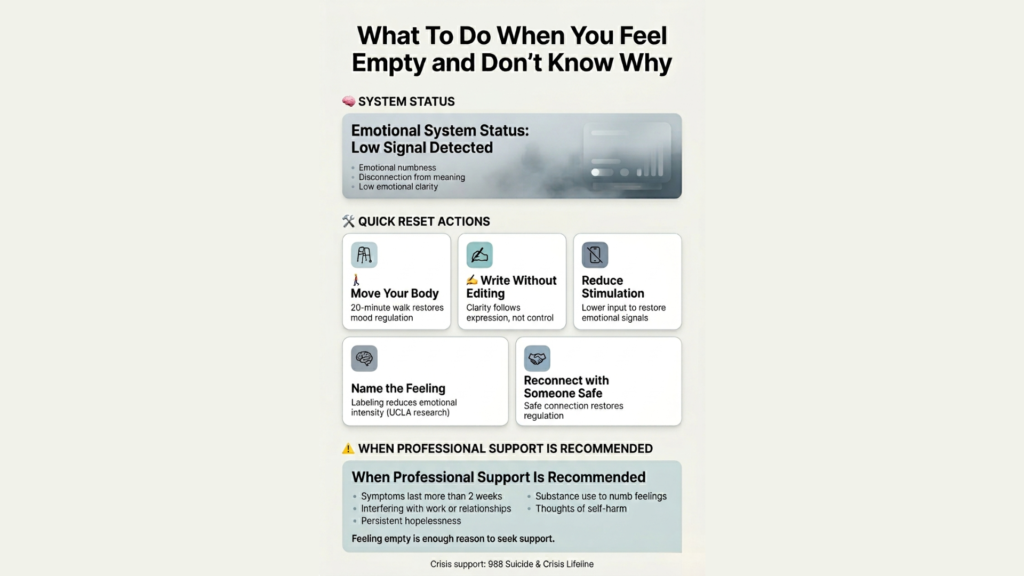
Emotional emptiness is not the same as having a bad day. It is a persistent psychological state, and it shows up differently for different people.
People who experience emotional emptiness commonly describe it as:
- Feeling hollow or “dead inside” without a clear reason
- Going through the motions of daily life without feeling present
- Losing interest in things that used to bring joy or meaning
- Feeling disconnected from loved ones
- A persistent sense that something is missing, but not knowing what
This experience is recognized by mental health professionals as a genuine psychological state, not a personality flaw. It can appear gradually over weeks or arrive suddenly following a significant life event.
Many people also notice a physical side to this feeling. If you’ve wondered why do I feel empty in my stomach during moments of stress or anxiety, there is a real explanation. The gut-brain axis, the communication network between your digestive system and brain, means emotional distress is frequently felt as a physical sensation. That hollow, sinking feeling of why do I feel empty inside my stomach is your nervous system responding to psychological pain, not a separate physical condition
Is Feeling Empty the Same as Feeling Sad or Numb?
These three states are related but meaningfully different. Understanding the distinction helps you identify what you are experiencing and communicate it to a professional.
The table below compares three commonly confused emotional states:
| Emotional State | Core Experience | Common Triggers | Key Difference |
| Sadness | A felt, active emotion | Loss, disappointment | You feel something, pain |
| Emptiness | Absence of feeling | Burnout, depression, grief | You feel nothing, hollow |
| Numbness | Emotional shutdown | Trauma, overwhelm | Protective blocking of feeling |
When people ask why do I feel empty and numb, they are often experiencing both simultaneously: a shutdown that began as protection and became a default state. Similarly, why do I feel empty and emotionless often points to emotional blunting, common in depression, prolonged burnout, or as a side effect of certain medications.
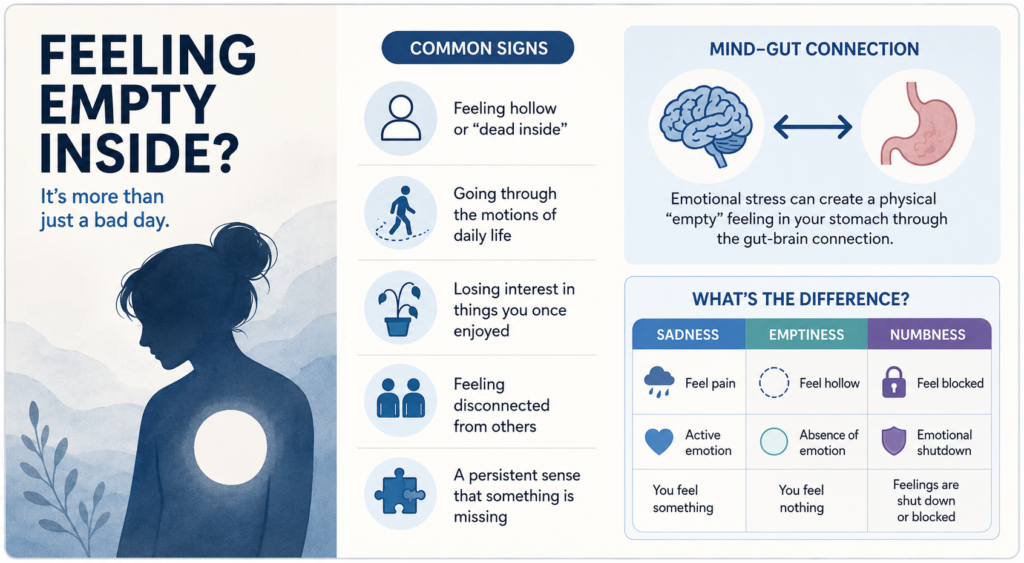
Why Do I Feel Empty? The 5 Most Common Reasons
Emotional emptiness is never random. There is always an underlying cause, and in most cases, it falls into one of five well-documented categories. Each one below is clinically recognized and treatable.
Could Depression or a Mental Health Condition Be Behind It?
Depression does not always look the way people expect. Many living with it describe their primary experience not as sadness, but as persistent emptiness. This is especially true for:
- Dysthymia, A low-grade, chronic form of depression lasting years
- Major depressive disorder (MDD), particularly in masked or early stages
- Borderline personality disorder (BPD), where chronic emptiness is a defining feature
- Bipolar disorder, especially during depressive episodes
According to the World Health Organization, over 280 million people globally live with depression, many describing emotional flatness rather than visible sadness. If you ask why do I feel so empty all the time despite a stable life, a mood disorder may be the driver. Why do I feel so empty inside without obvious cause is one of the most common presentations of high-functioning depression, and it responds well to treatment.
Can Burnout and Chronic Stress Make You Feel Emotionally Empty?
Burnout is not simply being tired. It is deep emotional, physical, and mental exhaustion from prolonged stress, and it depletes the inner resources that allow you to feel present or engaged. Warning signs include:
- Feeling detached from work, people, or things you once cared about
- Moving through your day on autopilot without genuine engagement
- Physical exhaustion that sleep does not fix
- Asking Why do I feel so empty despite staying constantly busy
This is why do I feel empty and numb after long periods of overwork or emotional labour. Academic burnout is equally real; students frequently experience emotional flatness that they misread as laziness, when it is their nervous system signalling overload.
Does Grief or Loss Cause That Empty Feeling Inside?
Grief does not require a death to take hold. The following can all produce genuine, lasting emotional emptiness:
- The end of a significant relationship
- Losing a friendship without closure
- A career loss tied to personal identity
- Major life transitions, leaving home, retiring, relocating
Grief-related emptiness rarely looks like tears. It often presents as quiet hollowness, a sense that something essential has been removed. This is why do I feel so empty and sad at once, or sometimes neither, just blank. Mental health professionals also recognize ambiguous loss: grief over someone still alive but emotionally unavailable. Why do I feel empty inside in these situations is a valid and recognized psychological response.
Why Do I Feel Empty After Sex, and What Does That Mean?
Feeling hollow or disconnected after a sexual encounter, even a positive one, has a clinical name: post-coital dysphoria (PCD). Research published in the Journal of Sex & Marital Therapy confirms it affects both men and women. Common experiences include:
- Sudden tearfulness or sadness after intimacy
- Emotional distance from a partner shortly after closeness
- A deflated, hollow feeling that is hard to explain
The causes of why do I feel empty after sex may include hormonal shifts post-intimacy, unmet emotional needs, or a disconnect between physical and emotional safety. This does not mean something is wrong with your relationship; it often signals a deeper emotional need that therapy can address.
Can a Lack of Purpose or Identity Leave You Feeling Empty?
Existential emptiness arises when a person lacks a clear sense of who they are or why their life has direction. Psychiatrist Viktor Frankl described this as the “existential vacuum”, an inner void that forms in the absence of meaningful purpose. It is especially common in:
- Young adults navigating identity for the first time
- People who have achieved goals and found them unfulfilling
- Those going through major life transitions
Why do I feel so empty all the time, even when life is objectively going well? Often, it traces back to this disconnection. Why do I feel empty and emotionless after achievement is a recognized phenomenon called “arrival fallacy”: the discovery that reaching a goal does not automatically produce the fulfillment you expected.
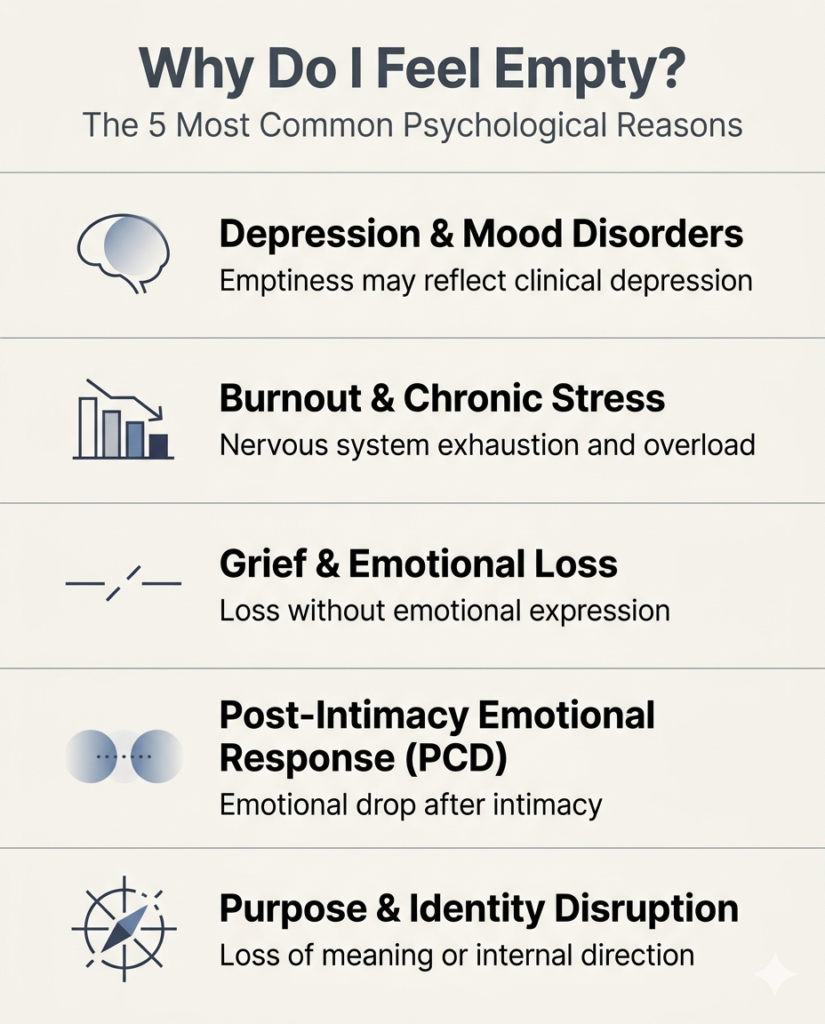
How Does Therapy Actually Help When You Feel Empty Inside?
The difference between self-help and therapy is not willpower; it is depth. Self-help addresses the surface. Therapy addresses the root. A trained therapist brings:
- Accurate identification of the underlying cause of your emptiness
- Evidence-based treatment matched to that specific cause
- Structured progress rather than cycling through the same feelings
- Practical tools you carry into everyday life long after sessions end
Therapy provides something difficult to find elsewhere: a space where your experience is taken seriously and met with genuine clinical expertise.
What Types of Therapy Work Best for Emotional Emptiness?
Different causes of emptiness respond to different approaches. The table below maps each cause to its most recommended therapy:
| Cause of Emptiness | Recommended Therapy | What It Does |
| Depression/mood disorder | CBT (Cognitive Behavioural Therapy) | Restructures unhelpful thought patterns |
| Identity / emotional regulation | DBT (Dialectical Behaviour Therapy) | Builds emotional regulation and self-awareness |
| Grief and loss | Grief Counselling | Processes unresolved loss in a structured way |
| Existential / purpose-related | Existential Therapy / Logotherapy | Reconnects the client to personal meaning |
| Trauma / post-coital dysphoria | Trauma-Informed Therapy | Addresses safety, attachment, and emotional needs |
What Should You Expect in Your First Therapy Session About This?
A first therapy session is primarily a conversation. Your therapist will ask open questions about your experience and background. There is no formal diagnosis, no pressure to share more than you are ready for, and no predetermined pace. Most people leave their first session feeling genuinely heard. There is no threshold of suffering required; feeling persistently empty is reason enough to begin.
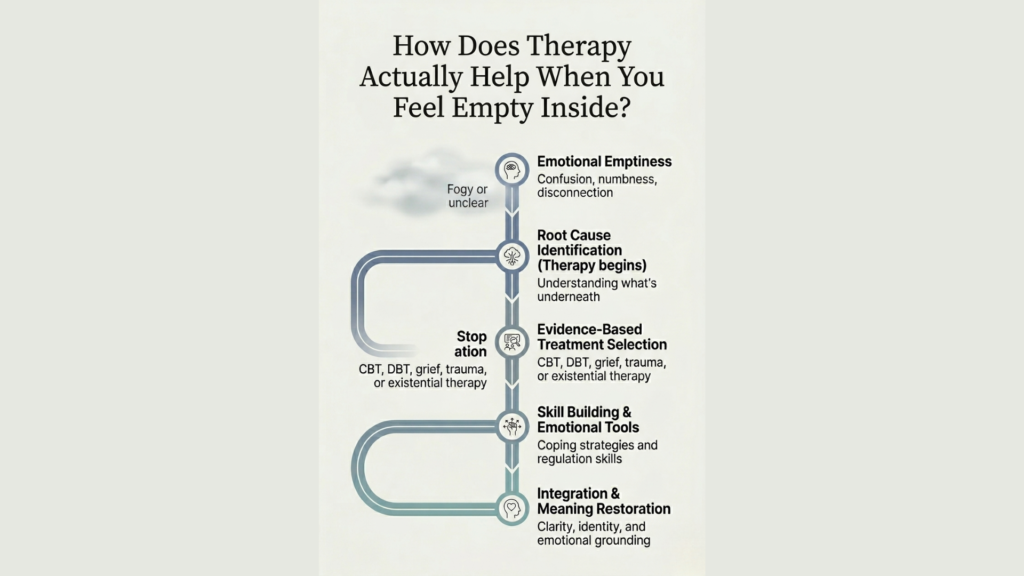
What Can You Do Right Now If You Feel Empty and Don’t Know Why?
These strategies are not substitutes for therapy. They are bridges, practical ways to care for yourself while moving toward professional support.
- Move your body gently. A 20-minute walk activates the body’s natural mood regulation systems. Start before you feel motivated; the benefit comes from beginning.
- Write without editing. Unstructured journaling externalizes the internal fog. Clarity follows the act of writing, not the other way around.
- Reduce stimulation. Constant scrolling suppresses the emotional signals your body is sending. Build small pockets of quiet into your day.
- Name what you feel. Research by neuroscientist Matthew Lieberman at UCLA shows that simply labeling an emotion measurably reduces its neurological intensity.
- Reconnect with one person. Not to solve anything, just to be in the presence of someone safe. Connection is one of the most evidence-supported antidotes to emptiness.
When Is Feeling Empty a Sign You Should Talk to Someone Professionally?
Seek professional support if:
- The feeling has lasted more than two weeks without improvement
- It is interfering with work, study, or relationships
- You feel persistent hopelessness alongside the emptiness
- You are using substances to numb the feeling
- You are having thoughts of self-harm
In a crisis, contact the 988 Suicide & Crisis Lifeline (call or text 988) for immediate support. To find a therapist, visit Psychology Today’s therapist directory and search by location and specialty.
Questions People Ask When They Feel Empty Inside
People searching for answers about emotional emptiness often phrase their questions in very specific ways. The following questions reflect exactly those searches, answered directly and without jargon.
Why do I feel so empty all the time even when life is going well?
This often signals anhedonia, the clinical inability to feel pleasure, which is a core feature of depression. When external circumstances are fine but inner life feels flat, the cause is almost always psychological, not situational. Why do I feel so empty inside in these moments warrants professional exploration.
Why do I feel empty and emotionless, is something wrong with me?
Nothing is permanently wrong, but something needs attention. Why do I feel empty and emotionless is commonly linked to chronic stress, masked depression, or emotional blunting from medication. It is always worth discussing with a doctor or therapist if it persists beyond a few weeks.
Why do I feel empty in my stomach when I’m anxious or sad?
The gut and brain communicate constantly via the vagus nerve. When emotional distress occurs, the body responds physically, producing that hollow, sinking sensation. Why do I feel empty inside my stomach? Is your nervous system translating an emotional signal, not a separate gastrointestinal issue?
Can feeling empty go away on its own without therapy?
Sometimes, if tied to a short-term stressor. But when emptiness persists beyond two to three weeks or worsens, it rarely resolves fully without support. Therapy shortens its duration and significantly reduces the risk of recurrence.
You Don’t Have to Sit With This Feeling Forever
Emotional emptiness is not a life sentence; it is a signal. The five causes explored in this article each have clear, evidence-based pathways to healing, and therapy is the most reliable way to find which path applies to you. If you have been asking why do I feel empty for longer than you can remember, that question deserves a real answer, not another article, but a conversation with someone qualified to help.